If you’re planning a short trip in north-western France and want a mix of history, coastal scenery, and iconic destinations, this 3-day itinerary covering Carnac, Auray, and Mont Saint-Michel is a great option.
We traveled through Brittany and Normandy by car, visiting Carnac, Auray and Mont Saint-Michel, combining ancient stone alignments and dramatic coastal landscapes. The route is also doable by train and bus, making it accessible even without driving.
This guide breaks down our exact 3-day route, including transport tips, food experiences, and honest impressions of each stop.
Day 1: Carnac & Auray
For lunch, we stayed in Auray, where we tried one of Brittany’s most famous dishes: galettes. It was a perfect, relaxed start to the trip.

In the afternoon, we visited the Carnac stone alignments.
Carnac is one of the largest prehistoric stone sites in Europe, made up of thousands of standing stones arranged across the landscape. The purpose of these stones is still uncertain today, which makes the site even more fascinating.
You can freely walk around the outer areas of the site, and there’s also a small road train that takes you around for a broader view. However, if you want to get close to the stones and really understand the history, you need to join a guided tour.
There are both English and French tours available, but the English one was fully booked when we visited. We joined the French tour instead and followed along using a translation app. It actually worked surprisingly well for catching key explanations from the guide.
What impressed us most about Carnac was not just the size of the stones, but the sheer number of them and the mystery behind how they were placed there. According to our guide, not all of the stones even come from this immediate area, which raises even more questions about how they were transported here.
Considering the limited technology at the time, it’s fascinating that people managed to gather and arrange so many stones in what appears to be a meaningful pattern, possibly for a purpose that is still unknown today.
Most of the explanations from the guide were based on theories rather than confirmed facts, but it was still very worthwhile to hear them. It adds a different layer of perspective when you are standing in front of the stones yourself.

Transportation-wise, we drove, but you can also take a TGV from Paris to Auray, which is usually faster. From Auray to Carnac, there are some buses, and if you manage to get an Uber, it’s about 20 minutes. Just note that return rides can be harder to find, so arranging a pickup with the same driver might be a good idea.
For dinner, we stayed in Auray again. What I liked was an appetizer with Camembert topped with caramelized nuts—it was unexpectedly amazing. We also had a gâteau breton for dessert, which turned out to be very filling.

We stayed in a centrally located Airbnb, which was comfortable for three people (although we never quite figured out how to properly use the sofa bed).
Day 2: Auray → Mont Saint-Michel
We started the morning with a walk around Auray. It’s a small town, but very charming, and the waterfront area has cafés and a relaxed atmosphere. It’s a great place for a half-day stroll, and we noticed quite a few tourists only stopping briefly.

One thing that stood out was how many houses and buildings had nautical decorations—fish, boats, and sea-themed signs were common throughout the town, which gave it a strong coastal identity.
Auray is located deep inside the Gulf of Morbihan, and if you have more time, it also seems like a great base for boat cruises around the gulf and its small islands.
From there, we headed to Mont Saint-Michel.
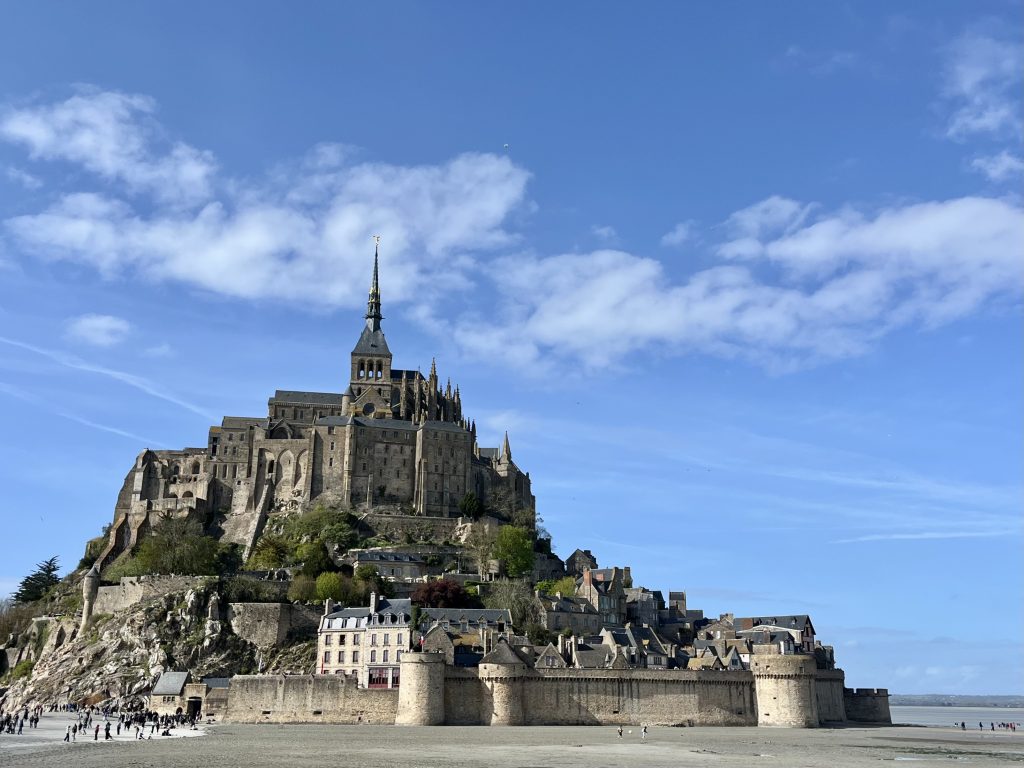
Mont Saint-Michel is one of the most famous landmarks in France and a UNESCO World Heritage site. It’s a medieval abbey built on a rocky island, surrounded by wide tidal flats that completely change appearance depending on the tides.
If you’re traveling by train, you can take a TGV from Auray to Rennes, then transfer to a bus to Mont Saint-Michel. Since also both Paris and Rennes are well connected by high-speed trains, the journey is quite straightforward even without a car if you travel from Paris.
We checked into the Mercure hotel located on the mainland opposite Mont Saint-Michel. From there, we took the shuttle bus to the island.
On this day, we didn’t visit the abbey yet. Instead, we spent time on the tidal flats, letting our son play in the mud with a small shovel we brought along (probably the only ones doing that, but it turned out to be a great experience).

Since it was low tide, there were many visitors walking across the sand. However, you can’t freely explore the area on your own, as the tides come in very quickly and conditions can become dangerous. Guided tours are generally recommended if you want to walk on the flats safely.
For dinner, we tried the famous omelette restaurant. Honestly, it’s more of an experience than a great meal—35 euros felt quite overpriced. We also tried the local lamb (prés-salé). It had no strong smell, though honestly we weren’t fully sure what made it stand out. It was still pleasant overall.

We stayed to watch the sunset before heading back to the hotel.
Day 3: Mont Saint-Michel Abbey & Return
We visited the Mont Saint-Michel Abbey around 9 a.m. We had booked tickets in advance, so there was no need to rush early. However, we noticed that the queue for pre-booked tickets was quite long at that time. In hindsight, buying tickets on-site might have been faster for early entry, although we’re not sure how reliably tickets are available at the entrance. Anyway arriving around that time meant the village was still fairly quiet, which was a nice contrast.

Breakfast options inside the Mont Saint-Michel village are very limited in the morning.
Around 9 a.m., most cafés and shops were still closed, and the only place open was a small entrance shop with poor reviews.
So it’s definitely safer to have breakfast at your hotel before going to the island. We personally just brought bread from Auray the day before, which worked fine.
We explored the abbey at our own pace using the audio guide. The weather and timing were perfect, as it was high tide, and the island was fully surrounded by water—completely different scenery compared to the previous day.
Inside the abbey, the architecture felt quite simple compared to more famous cathedrals like Notre-Dame in Paris. It is not particularly ornate or grand in decoration, although the cloister was especially beautiful.
In fact, the most impressive part of the visit was not so much the interior itself, but the view of the island from the outside. The dramatic setting and overall landscape are what make this place truly remarkable.

That said, understanding the geography and history of the site while walking through it definitely adds a lot to the experience and makes the visit much more interesting.
I had actually visited Mont Saint-Michel about 18 years ago, but coming back this time felt quite different. With a better understanding of its geography and history, the experience felt much deeper and more meaningful.
Even though traveling with a young child made things a bit hectic, we still had enough time to take everything in at our own pace. Overall, it felt very rewarding to return after so many years.
For lunch, we kept it simple with bread and salads near the hotel.
Before leaving, we stopped by local shops and picked up souvenirs such as cider, honey, Calvados, and salted caramel products.

Since it was the end of Easter holiday week, the return drive took over 6 hours instead of the expected 4 due to heavy traffic.
Traveling with a 4-Year-Old (What Worked and What Didn’t)
We traveled with a 4-year-old, and while the itinerary was manageable, it’s important to say that this route is not very stroller-friendly overall.
Carnac : has some flat walking paths where a stroller is usable, but access becomes difficult once you join the guided tour, which involves walking through grassy and uneven terrain. For families, the small road train is actually a better option—it’s easier for parents and more fun for kids.
Auray : has many steep slopes and cobblestone streets in the town center, which makes stroller use quite challenging.
Mont Saint-Michel : is also not ideal for strollers due to steep streets, stairs, and heavy crowds.
We brought a kick scooter for our child, as he’s really into it, but in reality, there were very few places where it was usable.
Around Mont Saint-Michel, it was only really practical in front of the hotel on the mainland. Elsewhere, the terrain (steep streets, cobblestones, and crowded areas) made it difficult or unsafe to use.
What our child actually enjoyed:
- Carnac: Picking flowers and finding insects in the fields. The stones themselves were not very interesting to him, but the open nature was fun.
- Auray: Watching the tide change in the harbor and noticing how the water level shifted at different times. The simple waterfront turned out to be surprisingly engaging.
- Mont Saint-Michel: Playing in the mud on the tidal flats. He was initially a bit confused (and slightly scared) as the water started rising, but once he understood it wouldn’t reach the village, he enjoyed watching the sea. Inside the abbey, he was mostly entertained by touching the audio guide device rather than the exhibits.
This 3-day trip through Brittany and Mont Saint-Michel offered a surprisingly rich mix of experiences—from prehistoric stone alignments in Carnac to peaceful walks in Auray and the unforgettable tidal landscape of Mont Saint-Michel.
What stood out most was how different each day felt. One moment you’re exploring ancient history in an open field, and the next you’re watching the tide transform an entire island.
If you’re considering a short road trip in France outside of Paris, this route is absolutely worth it—especially if you enjoy combining culture, nature, and local food in one journey.
It’s a compact itinerary, but one that leaves a strong impression long after the trip ends.